
.webp)
.webp)
.webp)
.webp)



More than 7 years since SB19-005 was signed into law, Colorado notches a huge victory with the FDA approving their program to import lower cost drugs from Canada.
The approval marks the culmination of one of the most ambitious state-level drug pricing initiatives in the country, and puts Colorado at the center of a growing national movement to reduce prescription drug costs through importation. But FDA approval is only the beginning. The harder questions involve what comes next: manufacturer cooperation, supply chain integrity, and unintended market consequences.
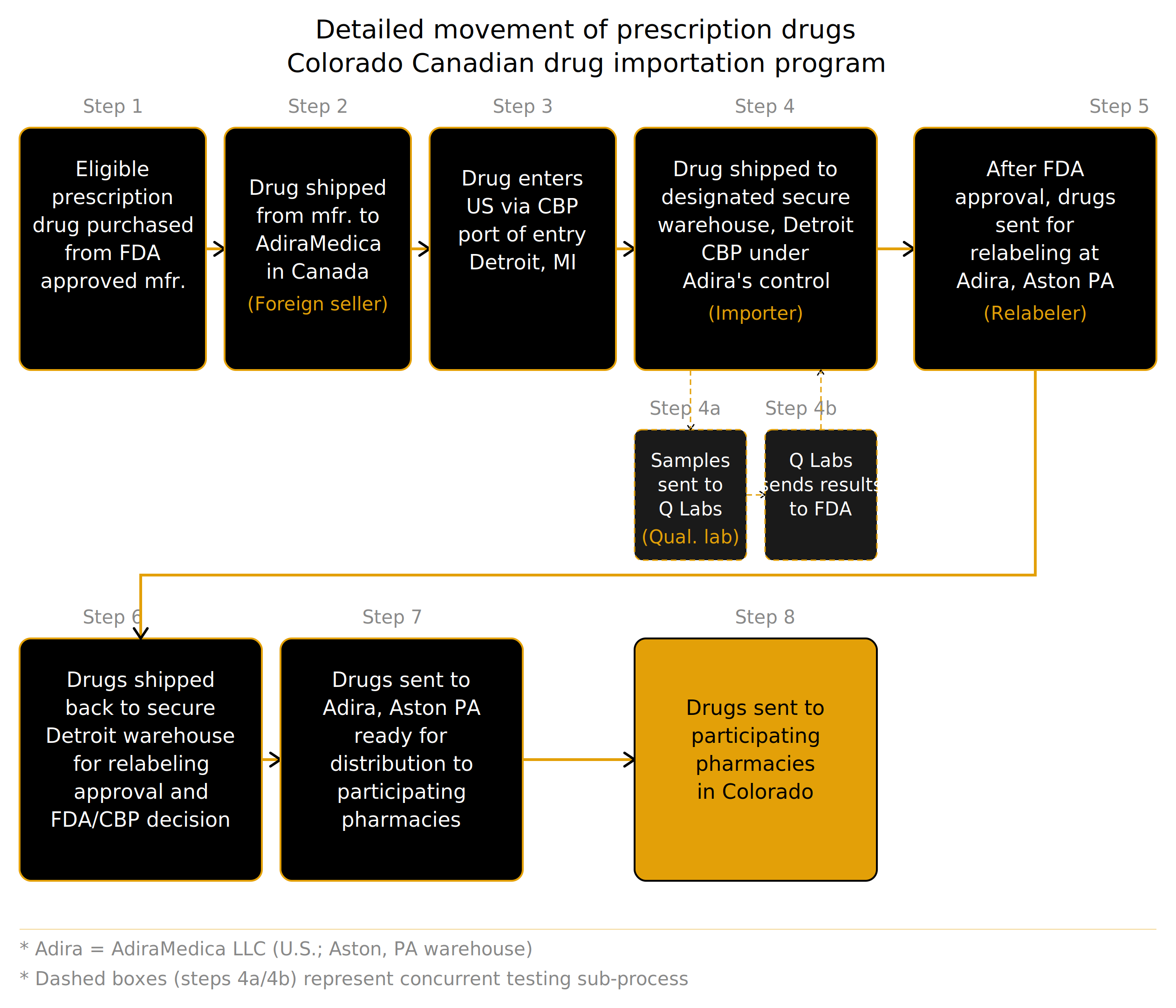
Colorado's program will run through Adira U.S. and Adira Canada, a licensed wholesale distributor, sourcing drugs from Mississauga, Ontario and importing them via the CBP port of entry in Detroit. Drugs are held in quarantine at a secure Detroit warehouse while Q Laboratories tests samples; and, FDA reviews results before anything moves.
Approved drugs are then transported to Adira's Aston, Pennsylvania facility for relabeling, returned to Detroit for a final FDA/CBP admissibility decision, and only then shipped to Colorado pharmacies. RMPDS will handle adverse event reporting and pharmacovigilance for the Colorado Program.
Although the Colorado State Board of Pharmacy regulates dispensing at the pharmacy level, same as any other prescription drug, the FDA will retain jurisdiction over all imported drugs in the state.
It is also worth noting that FDA's authorization is limited to a 2-year period, and comes with a hard deadline: if the importer does not file an electronic import entry for its first shipment within 1 year of the June 15, 2026 authorization date, the authorization is automatically terminated.
Before any drug can move, the importer must also submit a Pre-Import Request to FDA at least 30 days before a scheduled shipment arrival. FDA has noted that its review of those requests may itself exceed 30 days, meaning the practical lead time required is longer than the minimum. Every drug requires its own approved Pre-Import Request before it can be imported.
FDA approval is the necessary first step, but it is far from the last. The critical open question is whether pharmaceutical manufacturers will cooperate with programs generally.
Manufacturers are under no legal obligation to participate, and both Pharmaceutical Research and Manufacturers of America (PhRMA) and the Healthcare Distribution Alliance (HDA) have actively opposed state importation programs, citing concerns about counterfeit drugs and substandard products entering the U.S. closed distribution system. Canada itself has been unequivocal: Health Canada will not facilitate bulk drug exports, citing its own domestic supply concerns.
HCPF Executive Director Gretchen Hammer was direct at the announcement: “Now it is time for drug manufacturers to engage with the State, remove the prohibitions they have put on Canadian manufacturers, and be part of the prescription drug affordability solution.”
Without voluntary manufacturer engagement, or federal intervention to compel it, Colorado’s approval may be more symbolic than operational in the near term. As we noted in our 2019 coverage of Colorado’s insulin price cap, aggressive asynchronous drug pricing measures have a track record of producing unintended supply chain consequences so the Colorado Program will be worth watching closely.
FDA also retains broad authority to suspend or revoke the program at any time, in whole or in part, and for any individual drug within the program. That ongoing discretionary authority means that even a fully operational program carries regulatory uncertainty that manufacturers and supply chain partners will need to monitor continuously.
Understanding why Colorado's Program yields meaningful savings requires a closer look at how Canadian drug pricing works and where the discounts actually exist.
Generally speaking, brand drugs tend to be cheaper. The reason is multi-fold, but primarily because of the influence of PBMs in the USA versus there being a single-payer in Canada, i.e. Health Canada. Health Canada negotiates directly with brand companies to create the formulary so a lot of the PBM self-dealing is addressed.
However, Generics tend to be more expensive because only a few companies win very large contracts so there are fewer companies fighting for smaller slices of a smaller pie (US’s market is much larger).
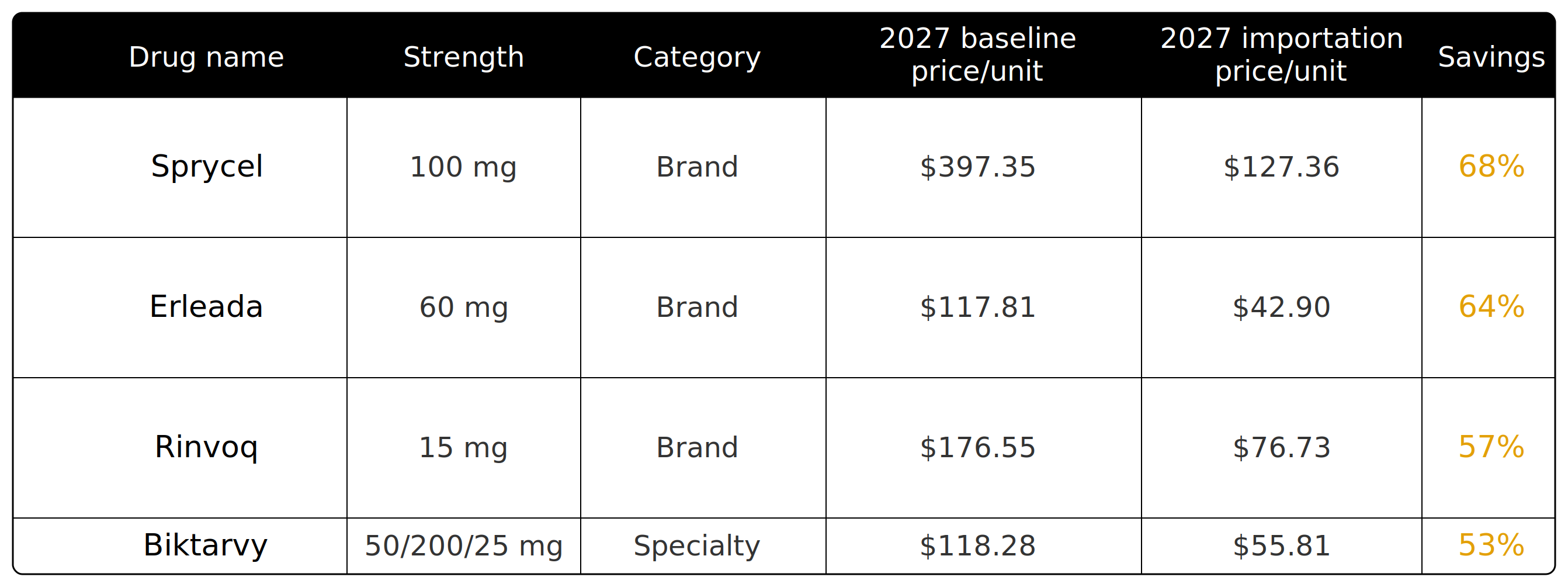
The pricing on specific products show a massive price discrepancy between Canadian and US pricing; at least 4 products yield a >50% discount on the brand price in the US.
See the full product list here
In May 2019, Colorado passed HB19-1216 to cap insulin pricing in the state at $100 per 30-day supply of insulin. Our coverage of the law primarily focused on the massive $1B+ grey-market within the diabetic supply chain, including insulin and test strips that exist; essentially, grey-market actors are dealing in previously dispensed products, and dispensing OTC versions of insulin as prescription versions.
However, diversion risk for the program seems to be limited. The required testing with samples should ensure testing quality. Additionally, with the FDA’s ongoing oversight and the fact the Program is limited to select approved pharmacies most likely means that arbitrage/diversion will be limited; at least, for now.
Florida was the first state to receive FDA authorization in January 2024 after submitting its application in 2020, following Colorado’s lead in 2019. Five other states, Maine, New Hampshire, New Mexico, Texas, and Vermont, have passed similar importation laws and are at various stages of pursuing FDA approval.
Not all have succeeded: New Hampshire’s application was rejected in 2022 for failing to identify a Canadian wholesaler. Colorado’s approval gives this movement renewed momentum, and a successful launch here will accelerate other states’ timelines.
For states watching Colorado's progress, the operational timeline matters as much as the authorization itself. The 2-year authorization window and 1-year activation deadline mean Colorado has limited runway to demonstrate a functioning program before other states can fully assess its viability as a model.
For manufacturers, distributors, and supply chain operators, Colorado's approval is a signal that state importation is no longer a theoretical policy debate. It is becoming operational reality, and the compliance and distribution implications will be worth monitoring closely as other states follow suit.








.svg)